

Prologue: A Light Across Time
There are moments in history when faith does not retreat into silence but steps forward quietly and steadily to shape the world. The story of the Aga Khan Development Network is one such moment unfolding across decades. It is not simply an institutional narrative; it is a living ethic rooted in centuries of Ismaili thought where spirituality meets responsibility, and belief becomes action.
Guided by the leadership of Aga Khan IV, the Ismaili Imamat has articulated a vision that dissolves the false divide between the sacred and the worldly. In this worldview, the act of building a school, restoring a historic city, or planting a forest is not separate from devotion; it is devotion.
This article journeys through that vision. It explores how an ancient ethical framework has shaped one of the most sophisticated global development networks of our time, and how that framework continues to respond to the challenges of a rapidly changing world.
Chapter I: The Ethical Foundation — Din and Dunya
A Sacred Balance
At the heart of the Ismaili tradition lies a concept that is both deeply spiritual and profoundly practical. It is the understanding that Din, which refers to faith, and Dunya, which represents worldly life, are not separate realms but parts of a unified human experience. This idea shapes how individuals understand their purpose in the world. Rather than viewing spirituality as something confined to private worship or isolated rituals, Ismaili thought encourages a life where faith is expressed through meaningful engagement with society.
This perspective offers a different way of seeing the world. It does not ask a person to choose between spiritual devotion and worldly responsibility. Instead, it invites both to exist together in harmony. A person’s work, relationships, and contributions to society become part of their spiritual journey. In this sense, daily life itself becomes a space where values are practiced and faith is lived.
Faith, in this tradition, is not meant to withdraw from the world. It is meant to engage with it. It calls for awareness of human needs and a willingness to respond with compassion and responsibility. Whether it is through education, service, or the pursuit of knowledge, every effort to improve the human condition is seen as an extension of spiritual commitment.
This understanding is carefully explored and preserved through institutions such as The Institute of Ismaili Studies. Through its research and publications, the Institute highlights how Islamic teachings encourage a balance between inner belief and outward action. It emphasizes that the material and the spiritual are not in conflict. There are two dimensions of a single responsibility that each individual carries.
To care for the world, therefore, is not separate from faith. It is a reflection of it. Acts of service, efforts to reduce suffering, and contributions to the well-being of communities are all ways in which devotion is expressed. In this light, honoring the Divine is closely tied to honoring humanity and protecting the world that sustains it.
The Imam as Ethical Compass
Within Ismaili Islam, the role of the Imam holds a central place in guiding this balance between faith and life. The Imam is not only a spiritual leader but also an ethical compass for the community. His guidance helps interpret enduring principles in ways that remain relevant to the changing conditions of the modern world.
Through speeches, guidance, and institutional leadership, Aga Khan IV has consistently emphasized that ethics must be lived in context. Values are not meant to remain fixed in theory. They must respond to the realities people face in their everyday lives. This approach ensures that faith remains dynamic and meaningful rather than distant or abstract.
A central theme in the Imam’s guidance is that ethical action must respond to present conditions. This means understanding the challenges of the time, whether they relate to poverty, education, health, or the environment, and addressing them with wisdom and care. Another key principle is that knowledge must serve humanity. Learning is not only for personal advancement. It carries a responsibility to benefit others and to contribute to the common good. Equally important is the idea that development must preserve dignity. Progress should never come at the cost of human respect or cultural identity. Instead, it should uplift individuals and strengthen communities in ways that honor their values and traditions.
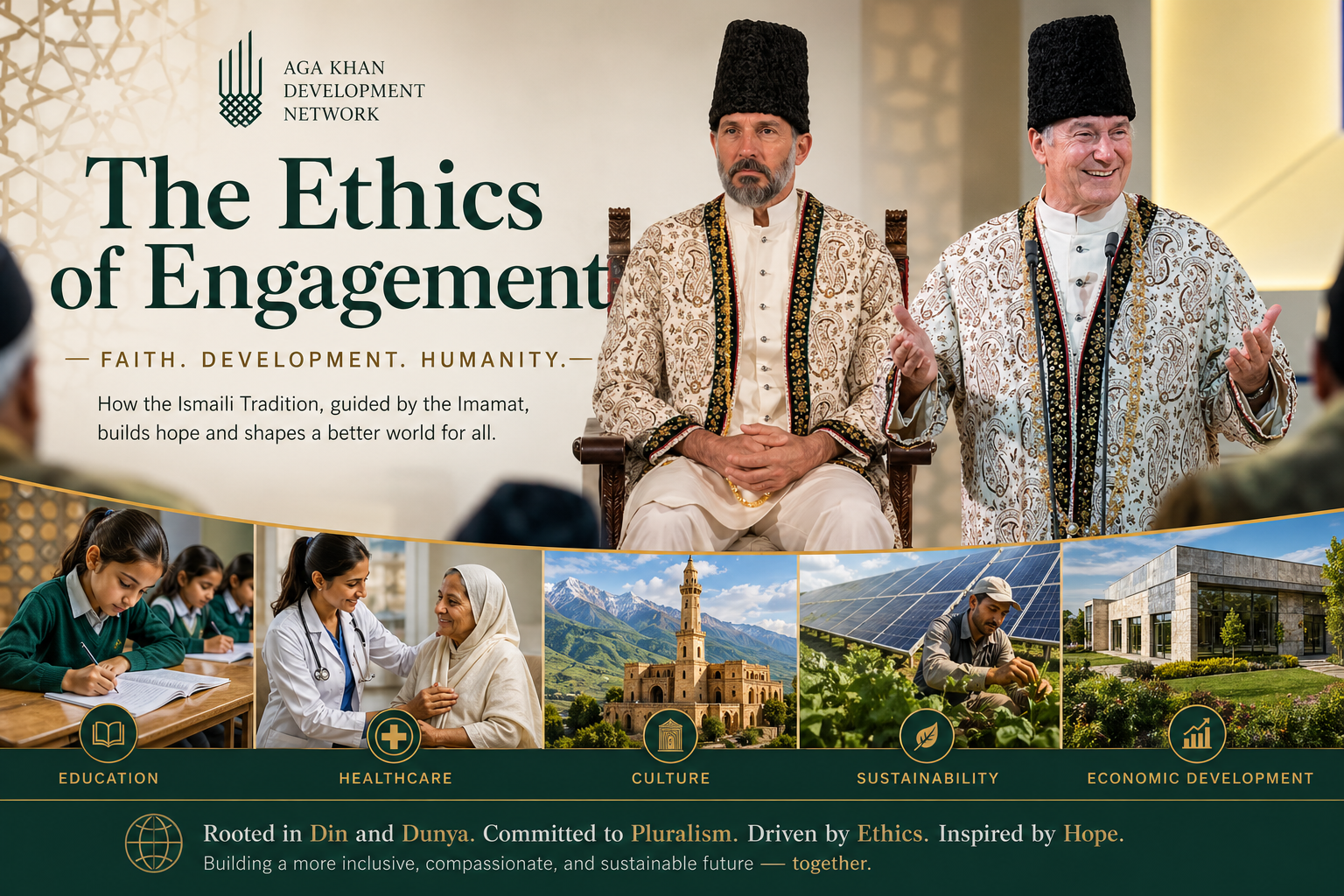
These principles are not limited to words. They are brought to life through the work of the Aga Khan Development Network. Operating across more than thirty countries, the AKDN translates ethical guidance into practical action. Its educational initiatives create opportunities for learning and growth. Its healthcare programs aim to provide quality care with compassion. Its cultural projects preserve heritage while supporting economic vitality. Its environmental efforts promote sustainability and responsibility toward future generations.
Through these efforts, the connection between faith and action becomes clear. The ethical vision of the Imamat is not distant or symbolic. It is visible in schools, hospitals, communities, and landscapes that have been transformed through thoughtful and sustained engagement. In this way, the Imam’s guidance continues to shape a model of development that is rooted in values, responsive to human needs, and committed to dignity in all its forms.
From Theology to Practice
One of the most distinctive features of the Aga Khan Development Network is the way it transforms belief into sustained action. In many contexts, theology can remain abstract, guiding personal reflection but rarely shaping systems or institutions. Within the Ismaili tradition, however, theology does not remain confined to thought. It moves outward, taking form in structures, programs, and long-term commitments that seek to improve human life.
This transformation is rooted in a different understanding of service. In many traditions, charity appears as an occasional act, often driven by immediate need. It responds to crises and offers relief, which is important and necessary. Yet the Ismaili ethical framework moves beyond this episodic model. It sees service as something continuous and structured. It becomes an act of building rather than simply giving.
This shift changes the nature of impact. Instead of focusing only on short term relief, the emphasis turns toward long-term resilience. Schools are established not only to teach children today but to educate generations to come. Healthcare institutions are designed not only to treat illness but to strengthen entire communities. Cultural restoration efforts do more than preserve monuments. They protect identity, memory, and a sense of belonging that sustains societies over time.
Behind these efforts lies a deeper conviction. Human dignity cannot be restored through aid alone. While assistance can address immediate needs, dignity is strengthened when individuals are given the tools to shape their own futures. Opportunity becomes the true measure of development. It allows people to move from dependency to self-reliance, from vulnerability to resilience.
Knowledge as an Ethical Obligation
Within this framework, education holds a central and sacred place. The pursuit of knowledge is not seen as optional or secondary. It is understood as a responsibility. In the Ismaili tradition, learning is closely tied to faith because it enables individuals to understand the world, make informed decisions, and contribute meaningfully to society.
Institutions such as Aga Khan University reflect this principle in practice. They are not simply places where information is transmitted. They are environments where knowledge is shaped by purpose. Students are encouraged to think critically, act responsibly, and approach their professions with a sense of service.
In this context, knowledge is never neutral. It carries ethical weight. It is expected to reduce suffering by improving healthcare and social conditions. It is meant to expand opportunity by opening pathways for individuals who might otherwise remain excluded. It also plays a role in cultivating ethical leadership, preparing individuals to make decisions that are not only effective but also just and compassionate.
This approach reflects a broader understanding of ignorance. It is not only the absence of information. It can also become a barrier that limits opportunity and perpetuates inequality. When people are denied access to education, they are often denied the ability to improve their circumstances. Addressing this gap becomes an ethical priority, not just an educational goal.
Ethics in Everyday Life
While institutions play an important role, the Ismaili tradition places equal emphasis on the individual. Ethics are not reserved for large-scale initiatives or public achievements. They are expressed in everyday actions, in the small decisions that shape daily life.
Honesty in trade reflects a commitment to fairness and trust. Compassion in relationships strengthens social bonds and fosters understanding. Responsibility toward the community encourages individuals to look beyond themselves and contribute to the well-being of others. These values are simple in expression, yet powerful in their cumulative effect.
Platforms such as The Ismaili continue to share and interpret these principles for contemporary audiences. Through stories, reflections, and guidance, they help connect enduring values with modern realities. This ensures that ethics remain relevant, adaptable, and grounded in lived experience.
What emerges from this approach is not a static set of rules, but a living ethic. It evolves with time while remaining anchored in core principles. It responds to new challenges without losing its moral clarity. Above all, it remains deeply human, centered on dignity, responsibility, and the shared goal of improving the world for all.
Chapter II: The Architecture of Hope
Building Beyond Structures
When architecture is mentioned, it often brings to mind images of buildings rising against the skyline, shaped by materials like stone, glass, and steel. Yet within the work of the Aga Khan Development Network, architecture carries a deeper meaning. It is not limited to physical construction. It becomes a way of shaping human experience, restoring dignity, and opening pathways for possibility.
In this context, architecture is not only about what is built, but about what is enabled. It is the thoughtful design of environments where people can live with purpose, connect with their heritage, and envision a better future. This philosophy is especially visible in the work of the Aga Khan Trust for Culture, where restoration projects extend far beyond aesthetics.
Historic sites are not treated as static monuments frozen in time. Instead, they are brought back into the life of the community. Spaces that were once neglected are transformed into vibrant centers of activity. Markets reopen, public spaces invite gathering, and cultural landmarks regain their meaning. In this way, architecture becomes a bridge between past and present, allowing history to inform progress without being left behind.
This approach reflects a broader ethical commitment. It recognizes that dignity is closely tied to identity. When communities see their heritage valued and preserved, it strengthens their sense of belonging. Architecture, therefore, becomes an instrument not only of design, but of respect and renewal.
The City as a Living Organism
Urban spaces within the AKDN framework are understood as dynamic and interconnected systems. A city is not simply a collection of buildings or infrastructure. It is a living organism, shaped by relationships, culture, economy, and environment. This understanding guides how urban development projects are approached.
In cities such as Kabul, Cairo, and Zanzibar, AKDN initiatives have demonstrated that meaningful transformation requires a balance of multiple elements. Cultural preservation ensures that history and identity are maintained. Economic revitalization creates opportunities for livelihoods and growth. Community engagement ensures that development reflects the needs and aspirations of those who live there.
Rather than imposing external models, these projects begin with listening. Local knowledge, traditions, and practices are treated as valuable resources. Development grows from within the community rather than being introduced from outside. This makes change feel natural and sustainable, rather than disruptive.
The outcomes extend beyond physical improvements. As neighborhoods are restored and public spaces are revitalized, there is a visible shift in how people experience their surroundings. A renewed sense of pride emerges. Communities reconnect with their environment and with each other. What takes place is not only urban renewal, but a deeper psychological transformation, where belonging and identity are strengthened.
Healthcare as Compassion in Action
Healthcare within the AKDN is approached as a responsibility rooted in ethics rather than a service driven by transaction. Access to quality healthcare is seen as essential to human dignity, and therefore it becomes a central focus of development efforts.
Hospitals and clinics established under the AKDN are guided by principles that emphasize accessibility, quality, and sustainability. These institutions are designed to serve diverse populations, often in regions where healthcare resources are limited. The goal is not only to treat illness, but to build systems that can support long term well being.
Yet what distinguishes this approach is the emphasis on the human dimension of care. Medical treatment is not reduced to procedures or efficiency alone. It is shaped by compassion and respect. Patients are approached as individuals, each with their own experiences, families, and aspirations. This creates an environment where care extends beyond physical healing to include emotional and social support.
Such an approach reflects a deeper understanding of health. Well being is not only the absence of disease. It is the presence of dignity, security, and trust. By addressing these dimensions together, healthcare becomes a space where ethics are practiced in the most direct and personal way.
Economic Development with a Conscience
Economic development within the AKDN reflects a model that moves beyond conventional definitions of growth. While financial sustainability is important, it is not the sole measure of success. Greater emphasis is placed on the broader impact that economic activity has on individuals and communities.
Through institutions such as the Aga Khan Fund for Economic Development, investments are directed toward sectors that generate lasting value. These include industries that create employment, strengthen local skills, and contribute to the stability of communities. The aim is to build economies that are resilient and inclusive rather than narrowly focused on profit.
This approach introduces an important shift in perspective. Economic decisions are guided by ethical considerations. The question is not only how much growth can be achieved, but how that growth affects people’s lives. Does it create opportunity. Does it empower individuals. Does it support long term sustainability.
By aligning economic activity with these questions, development becomes more than financial progress. It becomes a means of strengthening society as a whole. Communities gain the ability to support themselves, adapt to change, and pursue their aspirations with confidence.
In this way, the architecture of hope takes shape across multiple dimensions. It is visible in restored cities, in accessible healthcare, and in economies that prioritize human well-being. Each element contributes to a larger vision where development is guided by purpose, grounded in ethics, and directed toward a future defined by dignity and possibility.
Education as Infrastructure
If roads connect places, education connects possibilities. It opens pathways that are not always visible at first but become clearer over time as individuals grow in confidence, knowledge, and purpose. Within the work of the Aga Khan Development Network, education is understood as a form of infrastructure that is just as essential as physical development. It supports not only individual advancement but also the long term strength of societies.
Schools and universities established under this framework are designed with a broader vision in mind. They are not limited to the transfer of information. They aim to shape character, cultivate curiosity, and encourage a sense of responsibility toward others. Students are guided to think critically so they can understand complex realities, act ethically so they can make just decisions, and engage with the world in a way that reflects both confidence and respect for diversity.
Institutions such as Aga Khan University reflect this philosophy in practice. Learning environments are created where academic excellence is closely tied to ethical awareness. Students are not only prepared for professions but also for leadership roles that require integrity and compassion.
The impact of this approach extends far beyond the classroom. As individuals gain access to meaningful education, they carry that knowledge into their communities. They contribute new ideas, improve local systems, and inspire others to pursue similar paths. Over time, this creates a ripple effect where education becomes a shared resource rather than a personal achievement. Communities begin to transform from within, guided by individuals who are both skilled and ethically grounded.
Hope as a System
One of the most distinctive aspects of the AKDN’s work is the way its efforts are interconnected. Each initiative, whether focused on health, education, culture, or economic development, is part of a larger and carefully considered system. These efforts do not operate in isolation. They support and reinforce one another, creating a network of impact that is both stable and adaptable.
This coherence reflects a deeper understanding of development. Challenges faced by communities are rarely singular. Issues related to health, education, and economic opportunity are often closely linked. Addressing one area without considering the others can limit long term progress. By working across multiple sectors, the AKDN creates conditions where improvements in one area strengthen outcomes in another.
At the center of this approach lies a simple yet powerful idea. Hope is not something that appears by chance. It can be shaped through thoughtful planning, sustained commitment, and ethical intention. When systems are designed with care, they create environments where people can see possibilities for themselves and for future generations.
In this way, hope becomes more than a feeling. It becomes a structure that supports growth, resilience, and dignity. It is built through education that empowers, healthcare that heals, cultural efforts that preserve identity, and economic initiatives that create opportunity. Together, these elements form a system where progress is not temporary but enduring, guided by a vision that places human well being at its core.
Chapter III: Pluralism as a Moral Imperative
Beyond Coexistence
As the ethical framework of Din and Dunya takes shape in practice, it naturally extends beyond the boundaries of any single community. The Ismaili tradition does not view ethics as inward looking or limited to its own followers. Instead, it places strong emphasis on engaging with the wider world in a spirit of respect and shared responsibility.
Within this perspective, pluralism is not simply about allowing differences to exist side by side. It is about actively recognizing diversity as a source of strength. According to research and publications from The Institute of Ismaili Studies, Islamic thought, particularly in its historical expressions, has long engaged with multiple cultures, languages, and intellectual traditions. This engagement was not accidental. It reflected an understanding that knowledge and wisdom can emerge from many sources.
Guided by the leadership of Aga Khan IV, this principle has been articulated in contemporary terms as a moral imperative. Pluralism, in this view, requires effort. It involves building relationships, creating spaces for dialogue, and developing institutions that reflect diversity in meaningful ways. It is not limited to tolerance, which can sometimes imply passive acceptance. Instead, it calls for active engagement and mutual understanding.
Ethics of Inclusion
The work of the Aga Khan Development Network reflects this commitment through its inclusive approach. Its programs are designed to serve communities regardless of their faith, ethnicity, or background. This principle is clearly stated in AKDN policy frameworks, which emphasize improving quality of life without discrimination.
This approach is not only practical but also ethical. It recognizes that human dignity is universal and cannot be limited by identity. By working across diverse communities, the AKDN fosters environments where cooperation becomes possible. People from different backgrounds come together around shared goals such as education, healthcare, and economic development.
This model of inclusion helps reduce divisions that often arise from misunderstanding or lack of interaction. When individuals collaborate in addressing common challenges, they begin to see each other not as separate groups but as partners in a shared effort. Over time, this builds trust and strengthens social cohesion.
Institutions that Reflect Diversity
Pluralism within the Ismaili framework is also expressed through the creation of institutions that embody diversity. Educational and cultural initiatives supported by the AKDN are designed to bring together individuals from different backgrounds, encouraging dialogue and exchange.
For example, academic environments associated with AKDN initiatives often include students and faculty from multiple countries and traditions. This diversity enriches the learning experience and prepares individuals to navigate a complex and interconnected world. It also reinforces the idea that understanding others is an essential part of personal and professional growth.
Similarly, cultural programs emphasize the value of heritage from different regions. By preserving and presenting diverse histories, these initiatives highlight the shared human story that connects people across boundaries. This helps counter narratives that focus on division and instead promotes a sense of common humanity.
Pluralism as Responsibility
The concept of pluralism, as expressed in Ismaili thought, carries a sense of responsibility. It is not enough to acknowledge diversity. There is an obligation to engage with it in a way that is respectful and constructive.
This responsibility is reflected in the guidance of the Imam, who has consistently emphasized the importance of dialogue and understanding in addressing global challenges. In a world where differences can sometimes lead to conflict, the ability to engage across cultures becomes essential.
Publications such as The Ismaili often highlight examples of communities working together despite differences. These narratives demonstrate that pluralism is not an abstract idea. It is a lived experience that requires patience, openness, and a willingness to learn from others.
A Shared Future
As the chapter draws to a close, a clear pattern emerges. The ethical principles rooted in the Ismaili tradition do not remain confined to personal belief or community practice. They extend outward, shaping how individuals and institutions interact with the broader world.
Pluralism, in this context, becomes essential for building a shared future. It creates the conditions where cooperation can flourish and where diverse perspectives contribute to collective progress. It also reinforces the idea that dignity and opportunity should be accessible to all, regardless of background.
This understanding prepares the ground for the next stage of reflection. As global challenges continue to evolve, the application of these ethical principles must also adapt. In the following chapter, we will explore how this framework responds to emerging issues such as climate change and digital inclusion, and how it continues to guide efforts toward a more sustainable and equitable world.
Chapter IV: The Frontier of 2026 — Climate and Digital Inclusion
A Changing World, A Continuing Ethic
As the world moves deeper into the twenty first century, the nature of global challenges continues to evolve. Issues such as climate change and digital inequality are no longer distant concerns. They shape everyday life, particularly for communities that are already vulnerable. Within this changing landscape, the ethical framework of the Ismaili tradition remains steady, yet responsive. It continues to guide action through institutions like the Aga Khan Development Network, which adapts its work to meet emerging realities while remaining grounded in its core principles.
The idea that faith must engage with the world becomes especially relevant here. New challenges require new forms of understanding and action. Yet the underlying commitment remains the same. Human dignity must be protected. Opportunity must be expanded. Development must be thoughtful, inclusive, and sustainable.
Climate Responsibility as Ethical Duty
Environmental change is one of the most pressing concerns of our time. Rising temperatures, shifting weather patterns, and the increasing frequency of natural disasters affect millions of people, particularly in regions where resources are limited. Within the Ismaili ethical perspective, care for the environment is not separate from care for humanity. The two are closely linked.
Research and guidance from The Institute of Ismaili Studies highlight that stewardship of the earth is an important dimension of human responsibility. This idea is reflected in the work of the AKDN, which has integrated environmental sustainability into many of its programs.
Efforts in rural development often focus on improving agricultural practices in ways that protect natural resources. Water management projects aim to ensure long term availability while reducing waste. Urban initiatives include the creation of green spaces that improve both environmental conditions and quality of life. These actions are not isolated responses. They are part of a broader commitment to ensuring that development does not come at the cost of future generations.
This approach reflects a clear understanding. Environmental challenges cannot be addressed through short term solutions alone. They require sustained effort, informed by knowledge and guided by ethical responsibility.
Resilience in Vulnerable Regions
Many of the regions served by the AKDN are particularly exposed to environmental risks. Mountain communities, coastal areas, and regions affected by drought face challenges that are both immediate and long term. In these contexts, resilience becomes a key focus.
Programs are designed to help communities adapt to changing conditions. This may include supporting farmers in adopting new techniques, strengthening infrastructure to withstand natural disasters, or providing education on environmental management. The goal is not only to respond to crises but to prepare for them.
Such efforts demonstrate a shift from reactive to proactive development. Instead of waiting for challenges to emerge, systems are built to anticipate and manage them. This strengthens communities and reduces vulnerability over time.
Digital Inclusion as a New Dimension of Equity
Alongside environmental concerns, the digital divide has become a significant factor in shaping opportunity. Access to technology influences education, employment, healthcare, and communication. Those who lack access are often left behind, widening existing inequalities.
Within the ethical framework of the Ismaili tradition, this gap is recognized as an important area of concern. Knowledge has always been central to development. In the modern world, digital access is a key part of that knowledge.
The AKDN has responded by supporting initiatives that expand access to digital tools and education. Schools incorporate technology into learning environments, helping students develop skills that are essential for the future. Training programs equip individuals with the ability to use digital platforms effectively, opening pathways for employment and entrepreneurship.
These efforts are not limited to providing equipment. They focus on building understanding and confidence. Technology becomes meaningful when people are able to use it to improve their lives. This requires education, support, and an environment that encourages innovation.
Ethics in a Connected World
As digital systems become more integrated into daily life, new ethical questions emerge. Issues related to privacy, access, and the responsible use of information require careful consideration. The guidance of Aga Khan IV has consistently emphasized that progress must be accompanied by ethical reflection.
This means ensuring that technological advancement does not undermine human values. Systems should be designed to serve people rather than control them. Access should be inclusive rather than limited. Innovation should contribute to well being rather than create new forms of inequality.
Publications such as The Ismaili often explore these themes, encouraging communities to approach technology with both openness and responsibility. This balanced perspective helps ensure that digital progress remains aligned with ethical principles.
Toward an Integrated Future
The challenges of climate change and digital inequality may seem distinct, yet they are closely connected. Both affect access to opportunity. Both require long-term thinking. Both demand cooperation across communities and institutions.
The strength of the AKDN lies in its ability to address these challenges within an integrated framework. Environmental initiatives are linked with economic development. Educational programs incorporate digital skills. Healthcare systems use technology to improve access and efficiency. Each effort supports the others, creating a network of solutions that is both comprehensive and adaptable.
This integrated approach reflects the enduring principle that development must be holistic. It must consider the full range of factors that shape human life. By doing so, it creates conditions where progress is not only possible but sustainable.
A Continuing Journey
As this chapter concludes, it becomes clear that the ethical framework explored throughout this article remains relevant in addressing the complexities of the modern world. The integration of faith and action, the commitment to pluralism, and the focus on long-term development all contribute to a model that is both thoughtful and effective.
The frontier of 2026 is not defined only by challenges. It is also defined by opportunities to apply enduring principles in new ways. Through institutions like the AKDN, these principles continue to guide efforts that seek to improve lives, strengthen communities, and protect the future.
What emerges is a vision that is both grounded and forward-looking. It recognizes the realities of the present while remaining committed to the possibilities of tomorrow. In doing so, it continues the quiet work of shaping a world where dignity, knowledge, and responsibility remain at the center of human progress.
Conclusion: A Living Ethic in Motion
The journey through these chapters reveals a pattern that is both consistent and deeply intentional. From the foundation of Din and Dunya to the structures of development, from the commitment to pluralism to the response to emerging global challenges, a single thread runs throughout. The Ismaili tradition does not separate belief from action. It understands faith as something that must be lived, expressed, and continually renewed through service to humanity.
At the center of this vision stands the enduring guidance of the Imamat, embodied in the leadership of Aga Khan IV. Through this guidance, ethical principles are not left in abstraction. They are translated into institutions, initiatives, and practices that respond to the realities of each time. This has allowed the Aga Khan Development Network to grow into a model of development that is both principled and practical.
What makes this approach distinctive is its coherence. Education, healthcare, culture, economic development, and environmental stewardship are not treated as separate concerns. They are understood as interconnected dimensions of human well being. By addressing them together, the AKDN creates systems that are resilient and inclusive, capable of supporting communities over the long term.
Equally important is the emphasis on pluralism. The recognition that diversity is a strength shapes how institutions are built and how communities engage with one another. It fosters cooperation in a world often marked by division and encourages a shared sense of responsibility for the future.
Institutions such as The Institute of Ismaili Studies and platforms like The Ismaili continue to reflect and articulate these values, ensuring that they remain relevant in changing contexts. They provide both intellectual grounding and practical insight, connecting tradition with contemporary realities.
As the world faces challenges related to climate, technology, and inequality, the importance of an ethical framework becomes even more evident. Progress without values can lead to imbalance, but progress guided by ethics has the potential to uplift. The work of the AKDN demonstrates that development can be both effective and humane, both innovative and rooted in tradition.
In the end, this is not only a story about institutions or initiatives. It is a story about a way of thinking and living. It is about the belief that improving the human condition is a shared responsibility, and that this responsibility can be carried forward with knowledge, compassion, and integrity.
The ethics of engagement, as seen through the Ismaili tradition, remain a living force. They continue to evolve, to respond, and to inspire. And in doing so, they offer a quiet but powerful reminder that meaningful change is possible when faith and action move together, guided by a commitment to dignity and the common good.


